NC Clay Conference

Just back from the North Carolina Ceramics Conference held in Asheboro.  Six of us ladies from Southwestern Community College drove to the event a day ahead to have time to explore some potteries in Seagrove.

Headed to Seagrove?  I highly recommend visiting these potteries:

Bulldog Pottery – These two are GLAZE MASTERS!  My goodness…. their use of glaze materials to get the depth of surface is incredible.  Also, check out their lid system for their covered jars.  Amazing fit!

Westmoore Pottery– Traditional red clay slipware in a traditional tudor style building.  Visiting Westmoore is like stepping back in time.  If folk tradition is your thing, you must take a visit!  Beautiful, traditional pots.

McCanless Pottery –  Will had three distinct styles that he does quite well – a basic stoneware with lovely drawings based on maiolica tradition, beautiful crystalline glazes on classic vase shapes and traditional Seagrove Red on classical Chinese-type shapes.  All well-thrown and finely glazed.  You can also see some wonderful quilts by Scott Murkin, which adds to the pleasure of visiting McCanless Pottery.

NC Pottery Center – You cannot miss this museum/gallery hosting a historical museum of ceramics from the area as well as contemporary exhibitions.

There are soooo many potters in Seagrove, I am certain there are many others not to be missed; however we didn’t have time to visit them all and the above list is of those I visited and impressed me.

As for the conference,  it was great to be amongst ceramic lovers such as myself.  Two of my heroes in clay, Sarah Jaeger and Bruce Cochrane, demoed with Lorna Meaden, a fabulous potter.

The following is an image I took with my cellphone camera:
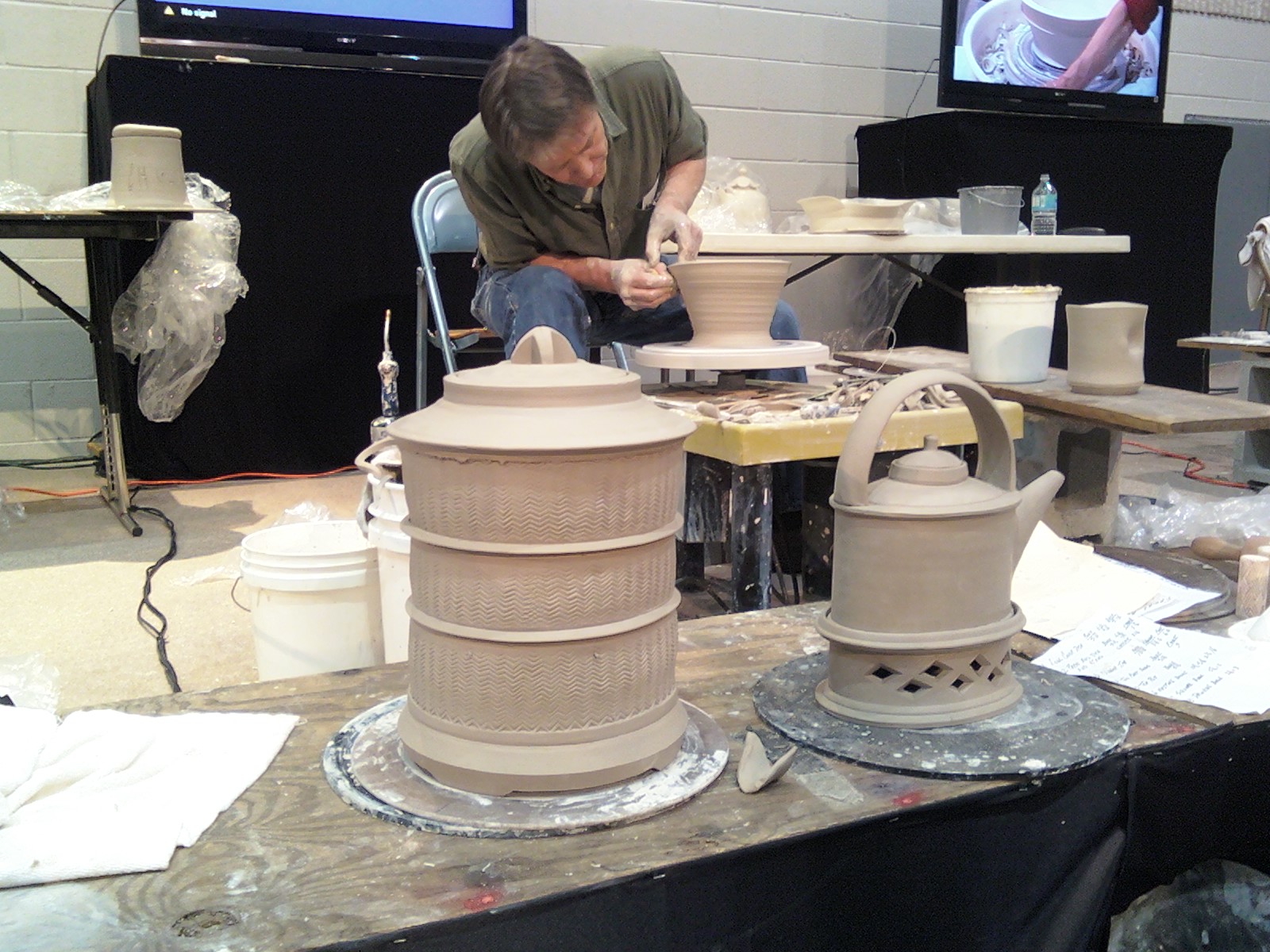
Bruce Cochrane with his demo pots completed

Bruce working on the wheel behind his demo pots.

Next year – NCECA!

Why earthenware?

Why earthenware? Not only does the rich color of the clay reference my natural surroundings and contrast nicely with my glazes, but earthenware has a rich history that I want to celebrate through my choice in clay.

Earthenware was the first clay used to make vessels. Before knowledge and technology became more sophisticated, people dug clay on riverbanks and fired their pottery in pits with any combustibles around (cow dung, wood, etc.) The majority of clay on earth is earthenware – so the majority of pottery was comprised of earthenware until people found other clay deposits and learned to mix clays. Along with finding those other clays, people had to learn to build kilns that got to higher temperatures. A pit heated with cow dung or piles of wood and straw will not reach temperatures high enough to vitrify stonewares and porcelain. Technology had to improve first.

Another aspect of earthenware that I like is its insulating properties. True earthenware, fired to the highest possible temperature without melting, is never totally vitrified. That is, the pots are not 100% water tight. The pores within the clay body act as insulation, allowing a hand to cup a mug filled with hot coffee and not burn, unlike porcelain which will get extremely hot to the touch. Of course, I must insist that my pottery does not leak. Not being 100% water tight does not mean a pot will leak on regular use. A coat of well-fitted glaze on the inside of a pot as well as a smooth application of a fine particled slip (terra sigilatta) on the bottom of the pot will ensure no liquid escapes in home use.

Along with insulating properties, earthenware distributes heat evenly. Therefore, baking in the oven with an earthenware casserole improves the cooking quality and taste to your food. A seasoned chef or foodie will be familiar with many traditional earthenware cooking vessels that are still in demand to coax the best flavors from the food – Moroccan tagine, French Daubiere, South American Cazuelas. Though some are able to be placed on the stovetop, my pottery is made for oven use, not atop a direct heat source.

For more information on Earthenware, I have created a page that links to many sites on the Internet that I have found helpful in explaining the properties of Earthenware, its history and showing contemporary potters that use the wonderful clay.

From now on, I intend to post Recipes for using my casseroles in the oven. Foods that I cook will not include meat; however I look forward to emails including recipes you have used that I can share with my readers. Pictures of the casseroles in use will also be much appreciated.

FYI: There are many high-end earthenware manufacturers today that produce pots for the oven. Many, if not all of these, are slip-casted earthenware pots. This means they are made in molds, not hand made. They are not individuals with the mark of the maker within. They are still fabulous pots; but for the price you pay (usually much higher than I will ask for a pot) you may consider getting yourself a ‘work of art’ that no other person will have. A unique, original, handmade pot that can be used to cook and to serve.

Here is a short list of manufactured earthenware pots to browse:

Bram Cookware; Emile Henry; Romertopf; L’Arelier Vert (Green Studio);

Potter’s Council Calendar Girl!!!

I apologize if this is a repeat of info…. I am constantly trying to update this site to make it look better.  I know, i know…. it needs help.  Well, I’m working on that and if you have any ideas or suggestions, PLEASE LEAVE A COMMENT!

So as I was saying, I am on the cover of the Potter’s Council Mug calendar for 2010 and also the month of September.  Please have a look:

You can purchase one at the Potters Council’s store.

I admit, I am very proud of this.  Of course, it is now February, so I will stop talking about it.  Thanks for looking.