Face Jug Workshop

Rob Withrow and Ted Cooley came to visit Southwestern Community College’s Heritage Arts program in Bryson City, North Carolina to show off their face jug style. They did a great job entertaining and teaching us how to make colorful, funny face pots.

Of course, the night started off with a pot luck, which means lots of fabulous food! Then Rob began working on his pots (about 3 feet each). Rob also brought one of his signature piggy bank pigs. When he and Ted were done with their first face, it was time for the students to get to work on their own.

This was a great workshop to share traditional Appalachian style pottery. Perfect for a school located in Western North Carolina! And all of our face pots will end up in our Manabigama kiln! Can’t wait to share those photos!

Enjoy the slideshow of the workshop!

This slideshow requires JavaScript.

Inspiration

I promised myself I would post a new blog post every Monday with a theme from my love of teaching.  Well, my last minute idea is about inspiration, specifically one of the many things that inspired my current work.  (This may not be a teaching post, but it may inspire ideas for students of pottery….)

Paper Cup and holder

Blast from my past - paper cup and plastic holder

My father owned his own business while I was growing up.  Actually, he owned several, as great entrepreneurs tend to do.  I have a fond memory of the water cooler in his store.  This cooler offered both cold or hot water and had cone-shaped paper cups in a dispenser on the side of the cooler.  Those paper cups would burn your hand with hot water, unless you used a little plastic holder with handle.  This was a reusable sleeve that offered a handle to keep your fingers away from the heat.  I found this plastic holder and cone-shaped cup to be intriguing.

As I began flirting with clay in my basement, after dedicating my time to librarianship for 5 years, I tried all kinds of shapes in the round.  I was searching for a form that I enjoyed making, was challenging enough not to bore me but also easy enough to make so that I could make enough to sell at a reasonable price; after all, I am a functional potter, not a clay sculptor.  Sure, I could have gone back to the pots of my past, but I no longer had access to a soda kiln to get the old decorations back, and I was using a new clay in a new place.  Time for a change.

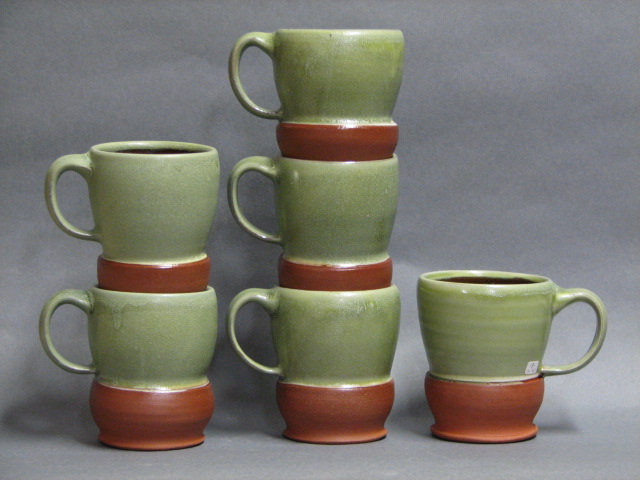
The potter’s wheel is only limited to round if you choose to leave the clay alone after forming your pot.  Play led to my flirting with ovals, squares, darts, etc.  Cutting and re-attaching clay (darting) or attaching bottoms to pots thrown with no bottom and ovaled seemed too complex for my idea of ease in process.  Then I remembered that plastic cup holder and thought I could use that idea to highlight the red clay by making the glazed part  look as though it was sitting within the bottom, unglazed earthenware.  This is all done while forming on the wheel – no need for attaching, unless handles are added.
mugs, stacked

Previous work - mugs inspired by plastic cup holder

Well, this got a bit boring.  It wasn’t challenging enough.

One spring day in the studio, after working in my garden, I came upon a budding flower and thought about how the green stem holds the paper-like flower within…. just as my inspirational plastic cup holds the paper cup within.  Flowers are much more beautiful than plastic/paper cups… and I am a novice gardener.  So why not see if I can reference a little bud in my pots?

Budding Flower - inspiration

generic Budding flower image thanks to pdphoto.org

And so I began to think of ways I could alter my pots just a bit more to make them unique, fun and a challenge to make, not too fussy as to become too expensive to create, beautiful, functional and referencing my love of my natural surroundings, specifically my garden sitting above this rich, red clay of Western North Carolina.  And of course, still working with that first image of my cone-shaped paper cup sitting in a plastic holder with handle.

A little practice and patience and I found a tool that I could use to dimple my pots, take them out of round, and reference the multiple layers of a flower coming up from the stem.  I like the way  food looks in these altered shapes, too.
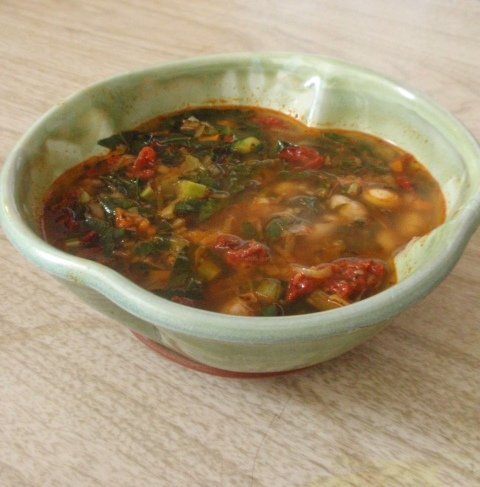
Soup in Pincu Pottery Bowl

Phil Gelb, a fabulous vegan chef in Oakland, CA and Cori Spence, assistant cook and food photographer, use my bowls!

And so I have been working with this idea ever since.  I play with new inspirations and attempt to create new ways of decorating, but the shape concept continues….

Currently, I am working on looking at a new inspiration that has come to me since making this work – fluted Korean celadon pots from 918–1392.  Keep tuned in to see if they inspire a new decorating technique, shapes, or who knows!

What inspires your pottery?

Throwing Hints and Tips

In my last post I linked to a few good sites for seeing pottery being made on the potter’s wheel.  There are many videos out there and many pages on making pottery – some are great and some not so great.  In thinking about my next post, I was going to add a few tips of my own… until I saw the BEST SITE FOR LEARNING TO THROW ONLINE!!!!!!

Marvin Bartel taught (retired, Professor of Art, emeritus) at Goshen College in Indiana.  He must be an incredible teacher (like me – sorry for the shameless plug)!  He is so generous with his knowledge online, I am quite certain he was just as generous, if not more, in person!  I sure hope he is still teaching a little and potting alot!

In case you just missed it, or were too lazy to click the link, Mr. Bartel took photos from the potter’s perspective and has a pretty comprehensive click-through on everything from wedging to centering to shaping and removing the pot from the wheel!!!  I had fantasized about doing this but don’t really have the set-up or patience for computer-type teaching.  THANK GOODNESS for this Learning to Throw online tutorial!!!! If you haven’t clicked yet and are just starting out in throwing pottery on the wheel, shame on you!!!!

Here are a few tips I linger on when teaching Beginner Pottery Wheel classes:

  • STABILIZE!!!  Brace your arm against your body when centering.  I throw right-handed and my left hand is the major player in centering on the wheel.  My elbow is stuck in my hip so that my body leans into the arm, which leads into my hand cupping the clay on the wheel, which centers the clay.  Essentially, I am using my upper body weight to center through my left hand. (the right hand plays a minor, yet important part in centering)
  • STABILIZE!!!  Never take your arms away from your body.  Holding them in close helps stabilize your arms so they don’t get knocked around by the clay.  Just think about how you take a long distance photo – arms are tight up against your body to help keep your hands from taking a shaky photo.
  • STABILIZE!!! When your hands touch the clay, your hands should also touch each other to help support and keep them from wobbling and getting off center.  This is especially important when pulling up the wall of clay.  If your hands aren’t touching, your outside hand will tend to move with the rotation of the clay which then throws your clay off center (actually it causes the clay to fold between your two fingers).
  • STABILIZE!!!! My arms are close to my body, my hands are touching and now my fingers, those little guys doing the pinching, have helpful neighbors who help give rigidity to weak, sorry digits.  Yes – I have each finger supported by another finger.  Whatever finger is touching the clay, another should be helping it out.  In my beginner’s class, I call the hand position the “crab claw.”  Our hand positions may not be exact, but you can see that my hands are touching, my fingers are touching and, what you don’t see is my arms tight against my body for STABILITY!
Hand position for throwing on the potter's wheel

"Crab Claw" hand position for beginner throwers.

In my next post, I hope to talk about my favorite tools for throwing…..  stay posted!